
The missing giants of Andreas

Like much Old English literature, Andreas did not survive to the present day intact. But unlike other fragmentary texts, this poem’s damage is quite limited and almost clinical. For unknown reasons, a single folio was ‘neatly’ cut from the sole manuscript copy of the poem.1
We can, however, make some reasonably certain guesses about what this missing page contained. This is because the story told in Andreas – an apocryphal tale of the Apostle Andrew and his adventure among fierce cannibals in the fantastical land of Mermedonia – is also told in several analogues. There are Old English prose homilies dating to the 10th and 11th centuries. There is a later Latin version, known as the Casanatensis, from the 12th century. And a potential indirect source for all of these – including the Old English poem – is a telling in Greek, known as the Praxeis.
Andrew’s adventure is consistent in the larger details across all four sources. The story begins after the Great Commission, with the Apostles having cast lots to determine their respective spheres of missionary work. Matthew has been charged with converting the Mermedonians, but on arrival he is captured, blinded, and bound in prison, where he – along with many other prisoners – waits for the day his captors will make him their meal.
Andrew is in Achaia, where he receives a command from Christ to rescue Matthew and convert the Mermedonians. At first Andrew hesitates, suggesting that an angel could accomplish the task more quickly, but he soon agrees and finds a ship to carry him and his disciples to Mermedonia. The ship’s captain - Christ in disguise – sets them down just outside the cannibals’ city, and Andrew’s resolve is strengthened after he realizes the captain’s identity.
Inside Mermedonia, Andrew makes his way invisibly to the prison, where he miraculously and instantaneously kills the guards outside, and enters the building to release Matthew and the other prisoners. Going back into the city to accomplish the secondary goal (conversion of the heathen Mermedonians), he has confrontations with the devil (who is acting as the leader of the cannibals) and undergoes a three-day ordeal of being dragged through the city. At the end of this torture, Andrew is prompted by Christ to look behind him along the streets, where he sees that his torn flesh and hair have been transformed into blossoming, fruit-bearing trees.
Now miraculously healed, Andrew sees a stone pillar (in all versions except the Old English poem the pillar has a statue atop it), which he commands to unleash a flood. This flood spreads through the city, and all but a few of the Mermedonians repent and are converted. These new converts beg Andrew to remain with him as their teacher; after seven days of instruction, Andrew departs – eager to return to Achaia for his own subsequent martyrdom.
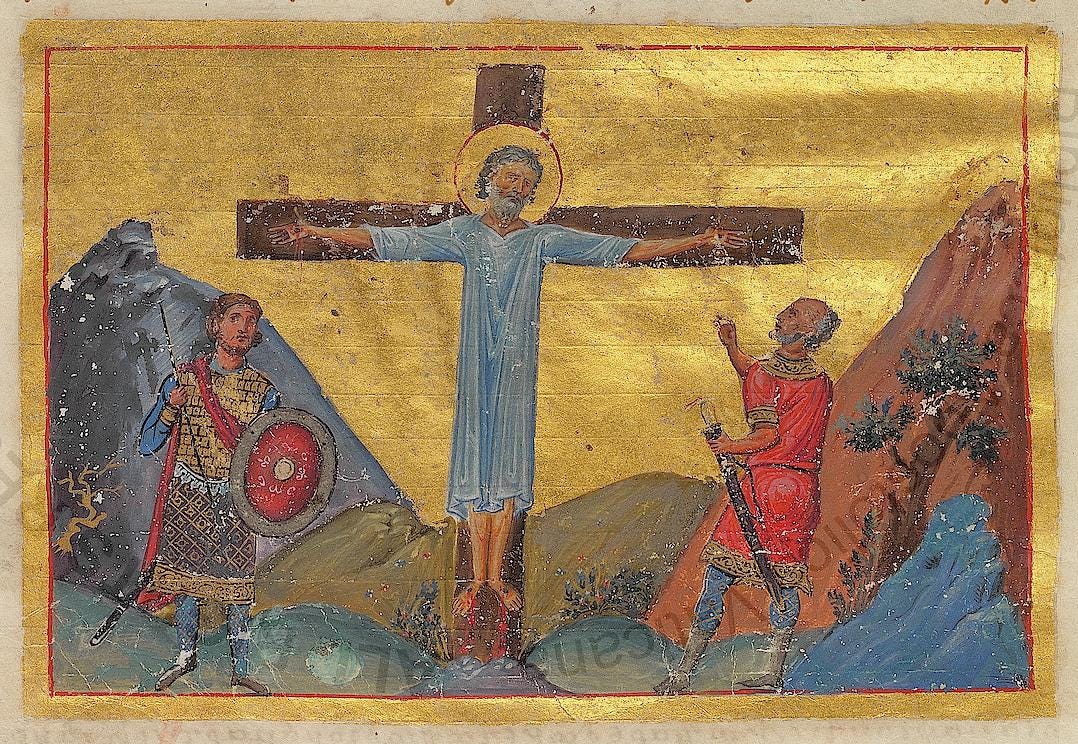
The missing page in Andreas comes just after Andrew has met Matthew in the prison. We have the first few words of Andrew to Matthew before the page breaks off. Our next page in the manuscript contains what must be the last line of this conversation.
Using nearby pages as a point of comparison, the poem’s most recent editors suggest that the missing page contained the equivalent of roughly 74 lines of verse. So what did these lines say?
The analogues provide some suggestion. Both the Praxeis and Casanatensis have Andrew making a speech denouncing the works of the devil and recounting his crimes. Chief of interest among these (given the focus of this Substack) is the legend hinted at in Genesis whereby diabolical angels slept with human women and engendered giants. In the Praxeis, the word used is gigantas.
Assuming that the Andreas-poet chose to follow the same path as the analogues in the content of Andrew’s speech, what word is he likely to have used here?
Andreas as we have it already contains two indirect references to “giants”. These are the descriptions of both the city streets and the pillar that unleashes the flood as enta aergeweorc (1235) and eald enta geweorc (1495), respectively.
Old English translations and retellings of Biblical stories often use ent to describe the giants of the Genesis legend. The Old English version of Orosius, written around the time of Andreas, refers to Nimrod as an ent. Aelfric of Eynsham, writing at the end of the 10th century, consistently uses ent to translate Biblical gigant.
On the other hand, gigant is not unheard of in Old English contexts. At around the same time the Old English Orosius called Nimrod an ent, Alfred’s Boethius uses gigant to refer to Nimrod and the builders of Babel. Gigant also seems to be more common in the earlier centuries of Anglo-Saxon literature. Its use is exemplified by the Old English poem Genesis, where gigantmaecgas (‘kindred of giants’, appearing in l. 1268) are positioned as the enemies of God and associated with the mingling of bearn godes (‘sons of God’, l. 1248) and Caines cynne (‘Cain’s kin’, l. 1249).2
Beowulf too uses gigant in, apparently, precisely the same way it is used in the analogues of Andreas: to describe giants before the Flood. Such use is evident in l. 113, where gigantas are said to have struggled with God before he paid them back (likely a cryptic reference to the Flood).3
Beowulf has long been recognized as an influence on Andreas. It would not be surprising, then, if the missing folio of Andreas used a form of gigant to describe the troubling offspring of angels and women in Genesis, even though elsewhere the poem refers to works of entas. Such use would be consistent with how the words appear in Beowulf, where surviving enta geweorc (such as the architecture of the dragon’s lair) seem to have little to do with the Biblical giants. Andreas, then, could have followed Beowulf in implicitly supporting a distinction between ancient builders (entas) whose works are still visible and the destroyed giants (gigantes) who warred with God.
But such a distinction did not endure throughout the Anglo-Saxon period. Perhaps Andreas itself helped to undermine it. After all, the action of the poem occurs not in Scandinavia but in a fantastical version of the Mediterranean and Biblical world. And as we have seen, later writers like Aelfric would use ent for Biblical giants – as well as for ancient pagan heroes. It is conceivable, then, that the Andreas-poet may have referred to entas rather than gigantas in his lost, purported discussion of the fallen angels interbreeding with human women. If so, he would have anticipated by around a century the position of Aelfric.
But this should not necessarily be a surprise, however used we may be to seeing Andreas as derivative rather than innovative. Above all, it is surely noteworthy that around the same time Andreas was being written, two works from a very similar milieu – the Old English Orosius and Boethius – used two different terms (ent and gigant) for the same figure (Nimrod). A shift in the semantic range of ent may have been generally in the air. And perhaps the Andreas-poet provided a nudge in his own way: by bringing ent-work to a legendary landscape not of pagan Northern kings and heroes, but of Biblical saints and Mediterranean cannibals.
The discussion of the missing section of the poem is found in Richard North and Michael Bintley, eds., Andreas: An Edition, p. 265. The editors do not hypothesize as to the cutter’s motives.
Quotations from Krapp, ed., The Anglo-Saxon Poetic Records 1, The Junius Manuscript.